2026-09-29T13:38:13.518Z ·
Why Red Clay Is Hard on Pipes Under a Slab
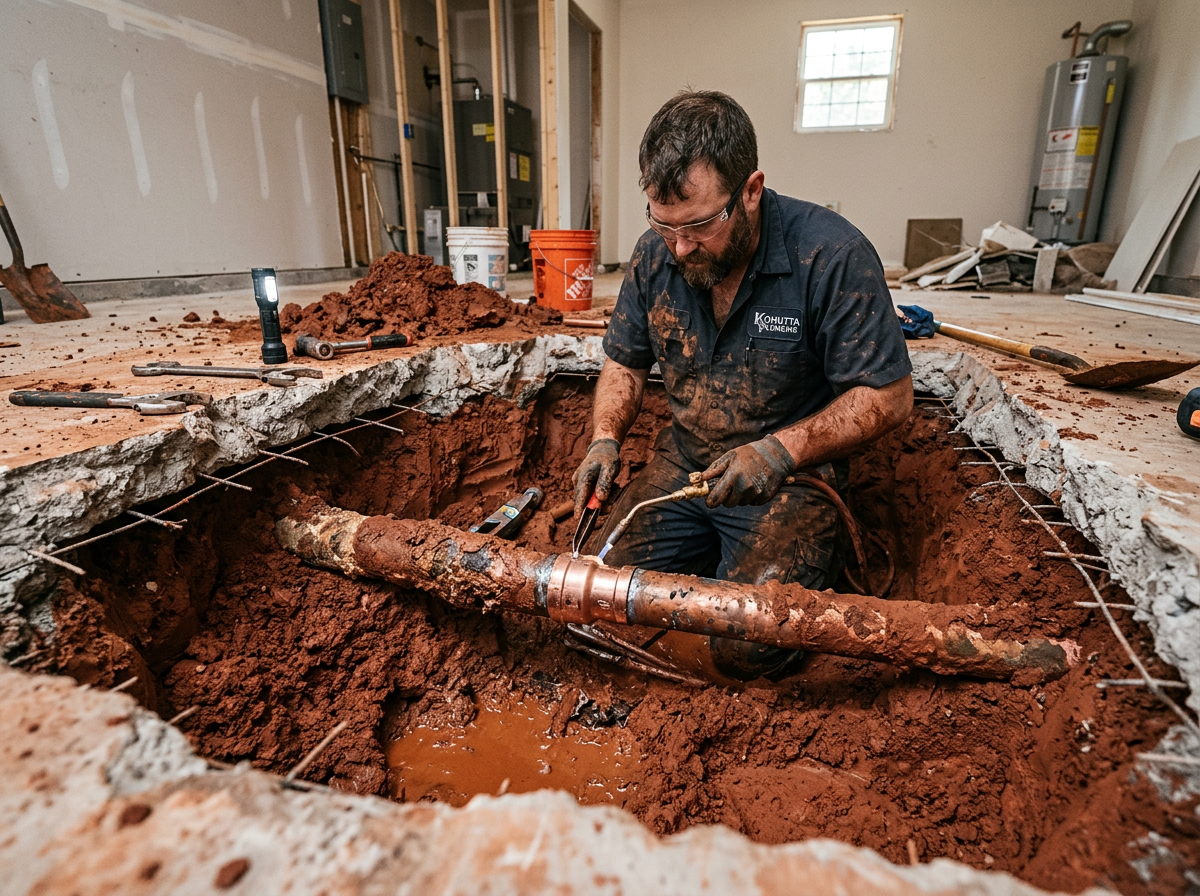
Anyone who has dug a garden in north Whitfield County knows the soil: dense, sticky red clay that holds water long after a rain and cracks when it dries out. That same clay sits under most slab foundations around Cohutta, and it plays a real part in why slab leaks happen here and how they behave.
What makes red clay different
Red clay gets its colour from iron oxides and its behaviour from very fine particles packed closely together. Two properties matter for plumbing under a slab.
- It holds water. Clay drains slowly, so moisture stays against the underside of the slab and around buried pipes for long periods.
- It moves. Clay swells when it is wet and shrinks when it dries. Over a year of wet winters and dry late summers, the ground under a house is always shifting slightly.
Neither of these would matter much if the pipes were hung in a crawlspace. Under a slab, the pipes are held in place by concrete above and clay below, and every small movement is transferred straight to the pipe.
How clay wears pipes out
Most slab leaks in older homes here are not sudden bursts. They are slow wear.
Copper supply lines were commonly laid in the gravel or clay under the slab when the concrete was poured. Where a pipe rests against a stone, a rebar tie or the edge of the concrete, it rubs a tiny amount every time the soil moves and every time hot water makes the pipe expand. Over twenty or thirty years, that rubbing wears a thin spot, and the thin spot becomes a pinhole leak.
Hot water lines take the most punishment because they expand and contract with every use, which is why a warm spot on the floor is such a common first sign. See hot water line slab leak repair for what that repair involves.
Why clay hides slab leaks
Clay also changes how a leak shows up. In sandy soil, a leak drains away downward. In clay, the water can't soak in easily, so it follows the easiest path, often along the outside of the pipe itself. It can travel several feet before it rises through a crack in the slab or appears at the edge of the house.
That means the wet carpet or damp baseboard you notice may not be anywhere near the actual break. Opening the floor where the water appears is how people end up breaking out more concrete than they need to. Proper slab leak detection with acoustic and thermal equipment finds the break itself.
What a long-running leak does to the foundation
Water pouring into clay under a slab softens it. Over time, softened clay can shift or wash out, and the slab above can settle unevenly. That shows up as cracked tile, doors that stick or gaps opening at baseboards. Stopping the leak early is the best protection, which we cover in foundation slab leak sealing.
Areas where this matters most
The community of Red Clay, right on the Tennessee line, is named for this soil, but the same ground runs under Cohutta, Varnell, Prater Mill and most of north Whitfield County. Older homes with original copper under the slab are the most exposed.
Can you prevent it?
You can't change the soil, but you can reduce the risk.
- Keep water away from the foundation. Working gutters, downspouts that discharge well away from the house, and soil graded away from the slab all reduce how much the clay swells right under the house.
- Watch the signs. Check the water meter now and then with everything off. A slow leak caught early is a much smaller repair.
- Consider a reroute after the first leak. If one line under the slab has failed after decades of wear, the rest of that line is often the same age.
If you want to spot a problem early, start with our list of the signs of a slab leak. And if a line has already failed once, read spot repair or reroute? before deciding on the fix.
Call for a quote if you think the clay under your slab is hiding a leak.