2026-09-29T13:38:13.518Z ·
Signs of a Slab Leak in a Cohutta Home
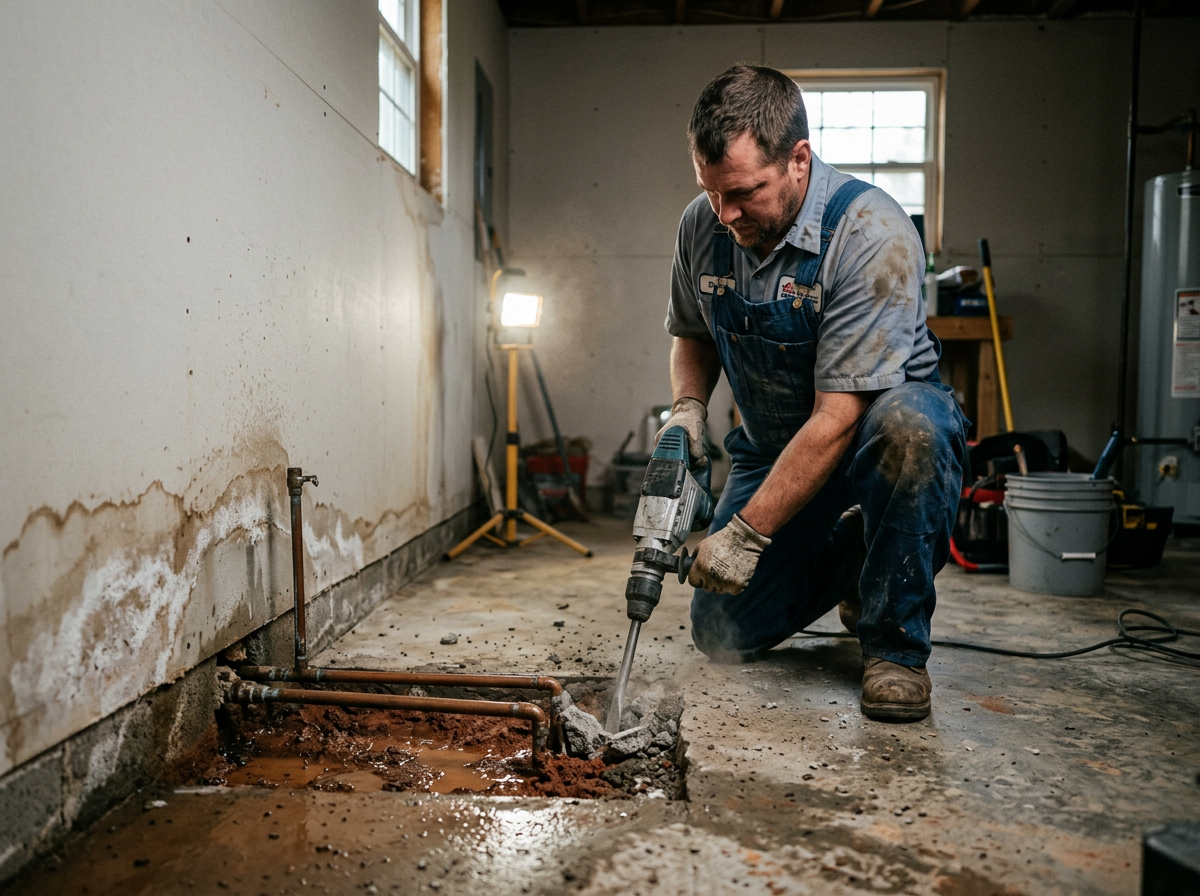
A slab leak is hard to spot because the pipe is buried in concrete. By the time most homeowners around Cohutta call about one, the leak has usually been running for weeks. The earlier you recognise the signs, the smaller the repair tends to be, and the less water ends up in the clay under your house.
This guide walks through the signs in the order people usually notice them, explains what each one points to, and tells you what to do next.
1. A warm or hot spot on the floor
This is the most reliable sign, and it points to a leak on a hot water line. Walk the house barefoot in the morning. A patch of tile, laminate or vinyl that feels noticeably warmer than the floor around it, often in a hallway, kitchen or bathroom, is heat coming up from water escaping under the slab.
Hot lines fail more often than cold ones because they expand and contract every time hot water runs. If you find a warm spot, read about hot water line slab leak repair, which covers what that repair involves.
2. The water meter moves when nothing is on
Your meter is the simplest test there is. Turn off every tap and appliance, then watch the leak indicator at the meter box for ten minutes. If it moves, water is going somewhere. Our step-by-step guide to reading your water meter shows exactly what to look for.
A moving meter alone doesn't prove a slab leak. A running toilet, a dripping outdoor spigot or an irrigation line can do the same. But a moving meter with no obvious cause is the point where professional leak location makes sense.
3. A water bill that climbs for no reason
Compare your last few bills with the same months last year. A steady climb, with no new people in the house and no change in how you use water, is a common early sign. Small slab leaks can run for months and only show up on the bill.
If you're on a private well, as many homes in rural north Whitfield County are, you won't get a bill. Instead, listen for the well pump cycling on when nobody is using water.
4. Damp carpet, swollen baseboards or a musty smell
Water from a slab leak has to go somewhere. Sometimes it rises through the slab and shows up as damp carpet along one wall, laminate that starts to cup, or baseboards that swell and separate. A musty smell in one room with no visible source is another clue.
In our red clay soil, the water often travels along the outside of the pipe before it surfaces, so the wet spot may be some distance from the actual break. That is one reason guessing where to open the floor goes wrong.
5. The sound of running water
If you can hear water running in a quiet house, with every fixture off, it is worth taking seriously. The sound often carries through the slab and is loudest near the leak.
6. Low water pressure across the house
A sudden drop in pressure at every fixture, not just one tap, can mean a larger break under the slab. If it comes with water surfacing through the floor, treat it as an emergency slab leak: shut off the main valve and call.
7. Cracks in tile or a floor that feels uneven
This is a later sign. A leak that has been running for a long time can soften and move the clay under the slab, which shows up as cracked tile or doors that start to stick. Stopping the leak early is the most important step for protecting the foundation, as we explain in foundation slab leak sealing.
What to do if you notice one of these signs
One sign on its own is worth a closer look. Two or more together make a slab leak likely.
- Check the water meter with everything turned off.
- Rule out the easy causes: running toilets, dripping taps, outdoor spigots.
- If water is surfacing, shut off the main valve or the valve at the meter box.
- Call to arrange professional slab leak detection before anyone opens the floor.
Leak location comes first because it decides everything that follows: whether the fix is a small repair through the slab, or a reroute that leaves the slab alone. Our article on spot repair versus rerouting explains that choice.
Why these signs are common around Cohutta
Many homes here sit on slabs over dense red clay, and a lot of them have copper supply lines laid straight into the concrete. Decades of hot water cycling through those lines, plus the slow movement of wet clay, is what wears them through. Homes in Varnell and across north Whitfield County share the same conditions.
If you're seeing any of the signs above, call for a quote on slab leak detection and repair.